Slack: Add a little contingency to your project

Meshed gears need "slack"
Meshed Gears need appropriate clearance or “slack”

“Slack” is a central idea of The Church of the Sub-Genius. They don’t define “Slack”, but they imply say that J.R “Bob” Dobbs is the embodiment of it.

I’m careful to respect the beliefs of others, even when I’m not sure they expect to be taken seriously, but you can find useful ideas in the strangest of places!

One way of looking at slack, is as time which is not allocated to productive activity. If we use this definition:

How can “slack” possibly make a project more successful?

Why we all need a little Slack

  • One reason for including a little slack is to account for uncertainty in estimates. If we schedule every task exactly the amount of time we think it will take and no more, and anything runs over time, then our completion date will start to slip.
  • Another reason for allowing a little slack is to allow people to review what they are doing (to “Think”, to use a once popular slogan). That way they can identify ways of doing their work more effectively and possibly improving their own productivity.
  • Finally, machines (like the gears in the illustration) which are operated without adequate clearances tend to require extra energy to drive them and break down more frequently. On the other hand, if clearances are too great, then gears become noisy and inefficient.

How do we know that we have the right amount of “slack”?

I am not arguing for inflating all estimates. Inflated estimates simply increase costs. Too much slack is as bad as too little. The signs that we have the wrong amount of “slack” or contingency are:

  • Too little slack: There is always difficulty completing any task on schedule. Even slight problems cause significant delays. Of course, there may be other reasons.
  • Too much slack: Everything is completed easily on schedule – in fact “the job is expanding to match the time available”.

How do we add “slack” to our project plan?

Slack can be added to individual tasks or to the project as a whole. It can also be added as recognised lower priority activities which we can decide to sacrifice if we need to. There are arguments for and against all approaches. Whatever approach you take, you should try and track how you are using any contingency you have added to your plan.

Is there the appropriate amount of “slack” in your project?

Look at whatever you are working on.

  • If the estimates are right “on average”, do you have enough “slack” to allow for the inconsistencies?
  • Do you have enough “thinking time”?

Project Tracking: Increase the probability you will achieve your goal

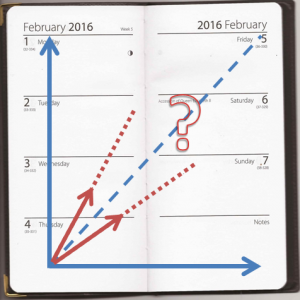
Graph of Actual versus Planned Progress

How are you getting on with your New Year resolutions? I’m doing pretty well with mine. I’ve been to the gym regularly week since the beginning of January, and several work projects are on track too. I have been “tracking” my achievements.

My question to you is:

“How do you know how well you are getting on?”

Why we need to track our projects

I said earlier that a New Year resolution should be SMART. Two of the letters are M for measurable and T for Time-bounded. If we are going to achieve our goal by the time we have set ourselves then we should be making progress towards it. If we are not making the progress we expect, then maybe we need to take action.
In order to monitor our progress we need to have some sort of tracking. We to be clear about our expectations (Plan) and we need to know what we have achieved (Actual). “Planned versus Actual” is what project tracking is all about, and it is one of the foundations of Project Management.

How do we track our project?

“Project tracking” sounds terribly formal but it doesn’t have to be complicated or bureaucratic. The key elements are “Plan”, “Actual” and periodic checking.

  • The Plan, or expectation of my New Year Resolution is to take “regular exercise, once or twice a week”.
  • The Actual is no more than a word in my (paper) diary.
  • The monitoring is looking at the “ticks” on the last weekend of the month. There is no formal report.

My advice is always to use “the simplest thing which could possibly work”, and to build it into whatever routine you have. Make monitoring and tracking what you do a habit.

Reap the benefits of tracking your work

Monitoring your work and your projects allows you to take control. Don’t assume that you will always be “behind”. Sometimes you will be ahead of where you expect to be and sometimes the problem will not be productivity but the plan.

Start today! A little self-monitoring can increase your feeling of control and allow you to work more effectively.

What do you do when things go well? Make a new plan!

A little while ago I shared my “Tactical Plan” with you. Things have gone well! So well that some of the projects have been completed much sooner than I expected. Some of this is down to good luck and having estimates which were not much better than guesses. The question is: what to do now?
I expect we are all (painfully) familiar with the situation where a project is slipping behind the intended schedule. Sometimes the reasons are the same as the reasons for my success: luck, inaccurate estimates and sometimes “force majeure”. After the inevitable struggle to get back on track by cracking the whip, the response is usually to re-plan. That is exactly what I have done in response to my recent success.
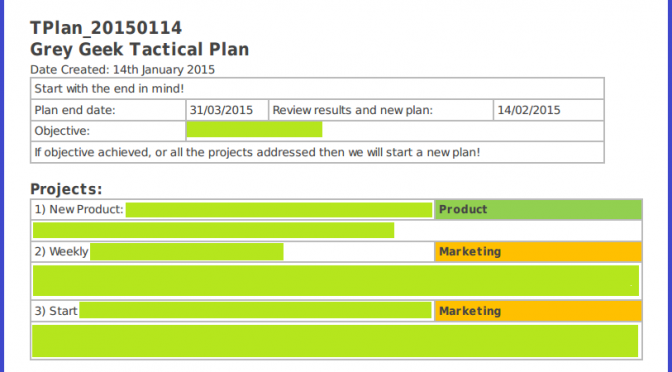
Here is the redacted version of my latest tactical plan. In structure it is identical to its predecessor. The changes are in the bits you cannot see.
Let me tell you about what is in the updated plan (without giving any secrets away):
  1. The objective was not achieved last time (but that would have been a miracle). So that has remained unchanged.
  2. The “New Product” development is still (more-or-less) on track, so that remains unchanged from last time. Basically it is – “Keep working away on the new product!”
  3. The “Marketing” project from last time has completed. It’s objective was to create something new. That has been done. Now I have a new project to use what was created by that project as part of a regular activity. I still call it a “project” because it certainly hasn’t become “business-as-usual” yet. I hope it will do eventually.
  4.  The “Administration” project from last time has been completed. It was necessary, and it is making things work more smoothly, but it is complete and there is no need for follow-up.
  5.  The completion of the “Administration” project has created an opportunity to start something new in the “Marketing”. That has already thrown up some interesting ideas, but the Tactical Plan is reminding me to focus on my current objectives. The new stuff can be considered for the next plan.   
The tactical plan is part of the project wiki (I may show you a little more of that in the future). It is visible to all the contributors and I have a printed copy above my desk, a little to my left, as I type. It is great as a means of reminding us all (especially me) what we have agreed we are concentrating on.